Where Did Halloween Come From? Samhain to Trick-or-Treat
 OriginPoint
1
Halloween began as the Celtic festival Samhain, was reshaped by the Church’s All Saints’ Day, and became trick-or-treating through Irish and Scottish immigrants in North America.
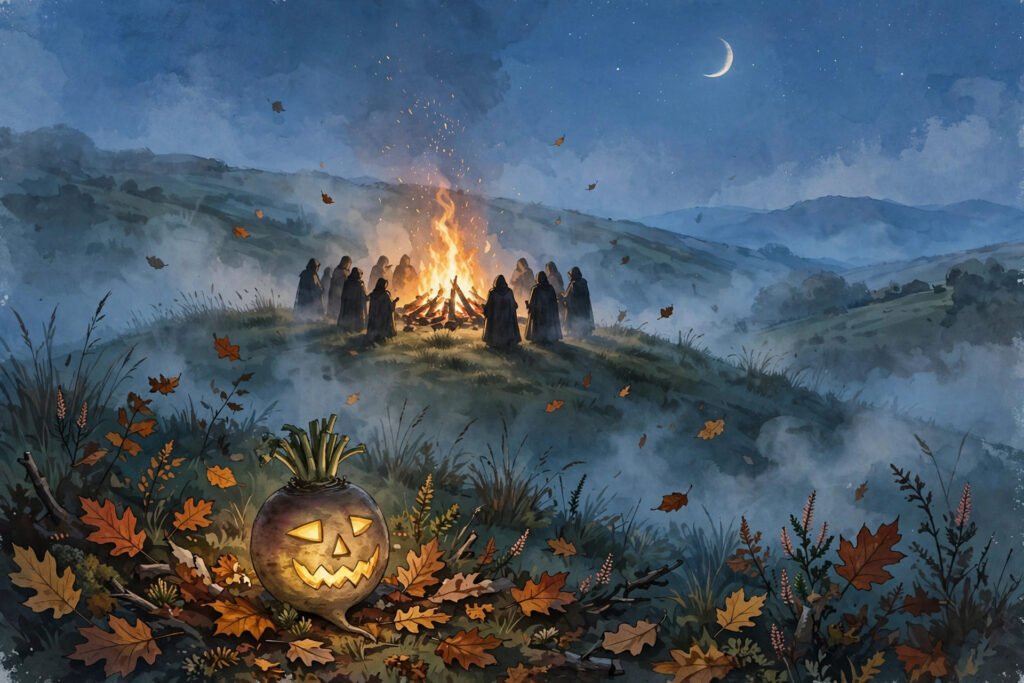
Where did Halloween come from? Halloween began as Samhain, an ancient Celtic festival marking the end of the harvest and the start of winter, and it reached its modern form when the Christian feast of All Saints' Day fell on the same date and Irish and Scottish immigrants carried the old customs to North America. The costumes, the carved pumpkins, and the children at the door are all pieces of that long journey.
Halloween is one of the few holidays whose name is a clue to its own history. "Halloween" is a shortening of "All Hallows' Eve" — the evening before All Saints' Day — and the word itself first appears in print in Scotland around 1745. But the festival behind the name is older than the Church calendar that gave it its title, and its roots run back more than two thousand years to the fields and fires of Celtic Ireland and Scotland.
What was Samhain?
Samhain (pronounced "sow-in") was one of the four great seasonal festivals of the ancient Celtic calendar, and it marked the most important boundary of the year. The Celts counted the year from Samhain: it was the end of the harvest, the day the cattle were brought down from the summer pastures, and the beginning of the dark half of the year. In early Irish literature, Samhain appears as a time when the normal rules of the world were suspended — the boundary between the world of the living and the world of the dead grew thin, and spirits could cross over.
The people of early Ireland treated that thin boundary with a mixture of respect and fear. Great communal bonfires were lit on hilltops, and households are recorded as extinguishing their own hearth fires and relighting them from the communal blaze — a ritual of shared renewal for the winter ahead. Offerings of food were left out for the ancestral dead, and the festival was associated in the old tales with gatherings, feasting, and encounters with the otherworld. The word "Samhain" itself means roughly "summer's end" in Old Irish, and it still survives today: 1 November is Lá Samhna, "Samhain Day," in modern Irish.
It is worth being honest about how much we do not know. The Celts left no written accounts of Samhain themselves; everything we know comes from later medieval Irish manuscripts, written down centuries after the festival's pagan height. Historians are careful not to over-claim. What the record does support is that Samhain was real, that it was the Celtic new year, and that it carried beliefs about the dead returning — the seed from which the modern holiday grew.
How did a Celtic festival become a Christian eve?
The turning point came in the 8th century, when Pope Gregory III moved the feast of All Saints' Day — the day honouring all saints — to 1 November. The evening before it, 31 October, became All Hallows' Eve. The Church's calendar placed a Christian feast squarely on top of the old Celtic date, and over the following centuries the two traditions braided together: the night for the dead kept its old character, but now it was framed by the Church's own calendar of saints and souls. The following day, 2 November, became All Souls' Day, a day for praying for the dead — a pairing that fit the old Samhain beliefs about the returning dead almost exactly.
By the Middle Ages, the customs we would recognise were already taking shape in Britain and Ireland. People went "souling" on All Saints' and All Souls' Days: poor children and adults went door to door asking for "soul cakes" — small spiced cakes — in exchange for prayers for the dead of the household. It was an early version of trick-or-treating, with the transaction reversed: instead of threatening a trick, the visitor offered a prayer. In Scotland and Ireland, meanwhile, people went "guising" — dressing in costume and going door to door, performing a song, a poem, or a joke in exchange for food or coins. The disguise, the old records suggest, was partly a game and partly protection: if the spirits were abroad, a mask might keep them from recognising you.
Where did the jack-o'-lantern come from?
The carved pumpkin is Halloween's most famous symbol, but the pumpkin is an American substitution. In Ireland and Scotland, people carved lanterns from turnips — a much harder and smaller vegetable, which made for eerie, cramped little faces. The lanterns were carried to ward off evil spirits, and they were tied to the folktale of "Stingy Jack," a trickster who, the story goes, outwitted the Devil and was condemned to wander the earth with only a burning coal inside a hollowed turnip to light his way.
When Irish and Scottish immigrants arrived in North America in the 19th century, they found a vegetable that made the whole business far easier: the pumpkin, native to the Americas, was bigger, softer, and far simpler to carve. The turnip lantern became the pumpkin jack-o'-lantern, and the name stuck. The first jack-o'-lanterns in America appear in the record in the mid-19th century, and by the early 20th century the pumpkin had become the holiday's emblem.
How did trick-or-treating begin?
The modern form of Halloween — children in costumes ringing doorbells for sweets — is a North American invention, and it is younger than most people think. The old customs of souling and guising arrived with Irish and Scottish immigrants, but they remained local, informal traditions through the 19th century. The phrase "trick or treat" itself first appears in print in 1927, in a newspaper in Blackie, Alberta, Canada, describing children going door to door. Through the 1930s the practice spread across the United States, helped along by newspaper coverage and by the simple fact that it was fun.
The Second World War interrupted it — sugar rationing made sweets scarce, and Halloween was quiet for several years. But in the late 1940s and 1950s it came roaring back, now shaped by a new force: post-war suburbia, where whole neighbourhoods of houses with front doors made door-to-door visiting easy, and by the growing candy industry, which saw an opportunity. By the 1950s, trick-or-treating as we know it — costumes bought or made at home, a bucket or bag, the phrase at the door — was established across America, and from there it spread back across the Atlantic and around the world. Even Britain and Ireland, where the traditions began, re-imported the American version in the late 20th century.
Other familiar pieces have their own histories. Bobbing for apples comes from old fortune-telling games played at harvest festivals, where catching an apple was said to predict marriage. The costumes shifted over time too: early guisers dressed as spirits and the dead, while modern costumes range from ghosts to superheroes — the disguise stayed, the cast changed.
Why does Halloween still feel ancient?
Halloween survives because it is a festival of boundaries, and boundaries never go out of fashion. Samhain marked the edge of the year; All Hallows' Eve marks the edge between the living and the dead; the costume marks the edge between who you are and who you pretend to be. That is a lot of history for one night — a Celtic new year, a Christian feast, a medieval begging custom, and an American candy ritual, all layered into a single evening. The carved pumpkin on the doorstep is the newest layer, but the fire behind it was lit more than two thousand years ago.
Frequently Asked Questions
Where did Halloween come from?
Halloween comes from Samhain, the ancient Celtic festival marking the end of the harvest on 31 October–1 November. The Church placed All Saints' Day on 1 November in the 8th century, making 31 October All Hallows' Eve, and Irish and Scottish immigrants later carried the customs to North America, where trick-or-treating took its modern form.
What is Samhain?
Samhain was one of the four great seasonal festivals of the ancient Celts, marking the end of the harvest and the beginning of winter. It was the Celtic new year, and it was believed that the boundary between the living and the dead grew thin at that time. Bonfires were lit, and food was left out for ancestral spirits.
Why do we carve pumpkins for Halloween?
The carved lantern comes from Ireland and Scotland, where people hollowed out turnips to ward off evil spirits, following the folktale of Stingy Jack. In North America, immigrants switched to the pumpkin — bigger and easier to carve — and the jack-o'-lantern was born.
When did trick-or-treating start?
The phrase "trick or treat" first appeared in print in 1927 in Canada, and the practice spread across the United States in the 1930s. It became a widespread national tradition after the Second World War, in the late 1940s and 1950s, as suburban neighbourhoods and the candy industry embraced it.


1 thought on “Where Did Halloween Come From? Samhain to Trick-or-Treat”