The Origin of the Croissant: Vienna, a Siege, and a Crescent of Dough
 OriginPoint
2
The croissant began as Vienna’s crescent-shaped kipferl, crossed to Paris with an Austrian baker in 1838, and only became the flaky, buttery pastry we know when French bakers reinvented it with laminated dough in the 1920s.
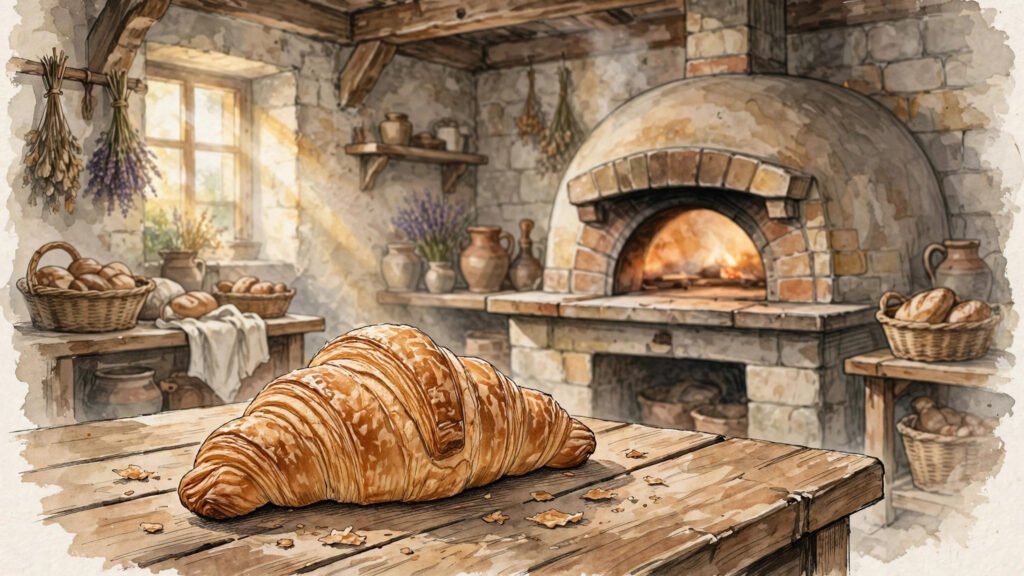
The origin of the croissant is not French at all — at least, not at first. The croissant began in Vienna as the kipferl, a crescent-shaped yeast pastry, and only became the flaky, buttery icon of Parisian breakfasts after an Austrian baker carried it to France in 1838 and French bakers spent the next century remaking it. The famous siege legend is mostly myth; the real story is better.
Where did the croissant actually come from?
It came from Vienna, Austria. The croissant’s direct ancestor is the kipferl (also spelled kipfel), a crescent-shaped roll that Austrian bakers had been making for centuries. The German word kipferl simply means “little crescent,” and crescent-shaped breads appear in Central European baking records long before the famous story set in 1683. That is the first surprise of the origin of the croissant: the shape predates the legend that supposedly created it.
The legend, told in bakeries and guidebooks everywhere, goes like this. In 1683, the Ottoman army laid siege to Vienna, surrounding the city for two months. To break in, Ottoman soldiers dug tunnels under the city walls. But Viennese bakers, working through the night in basement bakeries, heard the digging, raised the alarm, and helped save the city. In celebration, the bakers shaped a pastry like the crescent on the Ottoman banner — a symbol of the defeated enemy, now eaten for breakfast.
It is a wonderful story. Food historians, however, have found no contemporary evidence for it. There is no 1683 document describing bakers foiling a tunnel or inventing a celebratory pastry, and crescent-shaped pastries already existed in the region. The siege story seems to be a later invention, attached to an older pastry because it explained the shape so neatly. Historians now treat it as legend, not record — which makes the documented story that follows all the more interesting, because it is genuinely traceable, name by name.
Who brought the croissant to Paris?
An Austrian artillery officer turned entrepreneur named August Zang. In 1838, Zang opened the Boulangerie Viennoise — the Viennese Bakery — at 92 rue de Richelieu in Paris, selling the breads and pastries of his homeland, including the kipferl. Parisians, who had never tasted anything quite like Vienna’s yeast-raised, oven-fresh rolls, took to them at once. Zang’s shop became fashionable, and soon other bakers across Paris were copying his “Viennese goods.”
This is the documented turning point. The French word croissant also means “crescent,” so as the kipferl became a Parisian staple, it quietly acquired a French name. By the second half of the 1800s, the croissant — still closer to a soft, brioche-like roll than to the shattering, flaky pastry of today — was an established part of Parisian baking, and the bakers who specialised in Viennese-style pastries were known in France as viennoiserie, a word that still labels the whole family of breakfast pastries, from croissants to pain au chocolat.
What about Marie Antoinette? She is the other famous name in this story, and the legend says the young Austrian princess, homesick after marrying the future Louis XVI in 1770, asked the French court bakers to recreate the kipferl of her childhood, introducing it to Versailles decades before Zang. It is a charming image, but like the siege story, it rests on no solid evidence. No court record shows Marie Antoinette commissioning kipferl, and the pastry’s documented arrival in Paris points to Zang’s bakery, not the palace. The queen almost certainly ate crescent pastries in Vienna as a child — but she is not the reason Paris got the croissant. An ambitious baker with a shop on the rue de Richelieu is.
When did the croissant become flaky?
Here is where France truly earns its claim on the croissant. For roughly eighty years after Zang, the Parisian croissant remained a fairly dense, bread-like roll made from sweetened yeast dough. Then, in the 1920s, French bakers transformed it by adopting laminated dough — the technique of folding cold butter into yeasted dough, rolling it out, folding it again, and repeating the process until the dough holds dozens, even hundreds, of paper-thin layers of butter separated by dough.
Baked, those layers puff apart in the oven’s heat, the butter steaming between them, producing the croissant we recognise today: crisp and shattering on the outside, soft and honeycombed inside, leaving buttery flakes on the plate and, traditionally, on the shirtfront. This laminated croissant — technically called pâte feuilletée levée, yeasted puff pastry — is a French invention, and it is the reason the croissant tastes the way it does. Vienna gave it the shape and the name’s meaning; Paris gave it the layers.
That division is why the honest answer to “is the croissant French?” is both yes and no. Its shape, its ancestor, and its name’s meaning are Austrian. Its texture, its technique, and its status as a cultural symbol are French. The croissant is best understood as a collaboration across a century and a border, not the property of one city.
How did the croissant conquer the world?
Once the flaky croissant was perfected, it spread the way Parisian fashions always spread: through bakeries, cafés, and travellers who carried the habit home. The croissant-and-coffee breakfast became shorthand for a Parisian morning, and after the Second World War, as travel and French cuisine went global, the croissant went with them. American bakeries adopted it in the later 1900s, then filled it, flattened it, and reinvented it — almond croissants, chocolate croissants, croissant sandwiches, and, in the 2010s, the cronut craze’s cousin, the cruffin. Global chains now sell millions of croissants a day far from either Vienna or Paris.
And yet the original cities still guard their versions. In Vienna, the kipferl survives as its own pastry — often denser, sometimes topped with sugar or almonds, and served without any claim to be a croissant. In France, the croissant au beurre, made with pure butter rather than margarine, is a point of pride, and French bakers will tell you, with some justice, that a croissant made any other way is not quite a croissant at all. The rivalry is friendly, and it is fitting: two cities, one pastry, and a story that belongs to both.
So the origin of the croissant is a tale of two cities and one shape. A crescent roll baked in Vienna for centuries, carried to Paris by August Zang in 1838, renamed in French, and finally rebuilt layer by layer into the flaky pastry the world queues for each morning. The siege legend may be a myth, but the real history — a baker, a bakery on the rue de Richelieu, and a century of patient reinvention — is every bit as good.
Croissant origin at a glance
| When | What happened |
|---|---|
| Vienna, centuries before Paris | Kipferl, a crescent-shaped yeast pastry |
| 1683 legend/myth | Siege story: bakers foil a tunnel; no contemporary evidence |
| 1838 to France | August Zang opens Boulangerie Viennoise in Paris |
| France, 1920s | French bakers adopt laminated dough; flaky croissant |
Related reading: Who Invented the Sandwich?; Who Invented the Zipper?; Where Was Pizza Born?
Frequently Asked Questions
Where did the croissant originate?
The croissant originated in Vienna, Austria, as the kipferl, a crescent-shaped yeast pastry baked there for centuries. It came to Paris in 1838 with August Zang’s Boulangerie Viennoise and became the flaky pastry we know when French bakers adopted laminated dough in the 1920s.
Is the croissant French or Austrian?
Both, in different ways. Its ancestor, shape, and name’s meaning are Austrian; its flaky laminated texture and its status as a breakfast icon are French. The modern croissant is a French reinvention of an Austrian pastry.
Is the 1683 Vienna siege story true?
Almost certainly not. No contemporary evidence links the kipferl’s creation to bakers foiling an Ottoman tunnel during the 1683 Siege of Vienna, and crescent-shaped pastries predate the siege. Historians treat the story as a later legend that neatly explains the shape.
Who brought the croissant to France?
August Zang, an Austrian entrepreneur, brought Viennese baking — including the kipferl — to Paris when he opened the Boulangerie Viennoise at 92 rue de Richelieu in 1838. The kipferl then gradually took the French name croissant, meaning crescent.





2 thoughts on “The Origin of the Croissant: Vienna, a Siege, and a Crescent of Dough”