Where Did Coffee Come From? The Kaldi Legend and the Road from Yemen
 OriginPoint
2
Coffee began as a wild Ethiopian cherry, was first brewed by Sufi monks in 15th-century Yemen, and travelled through the port of Mocha to conquer the world.
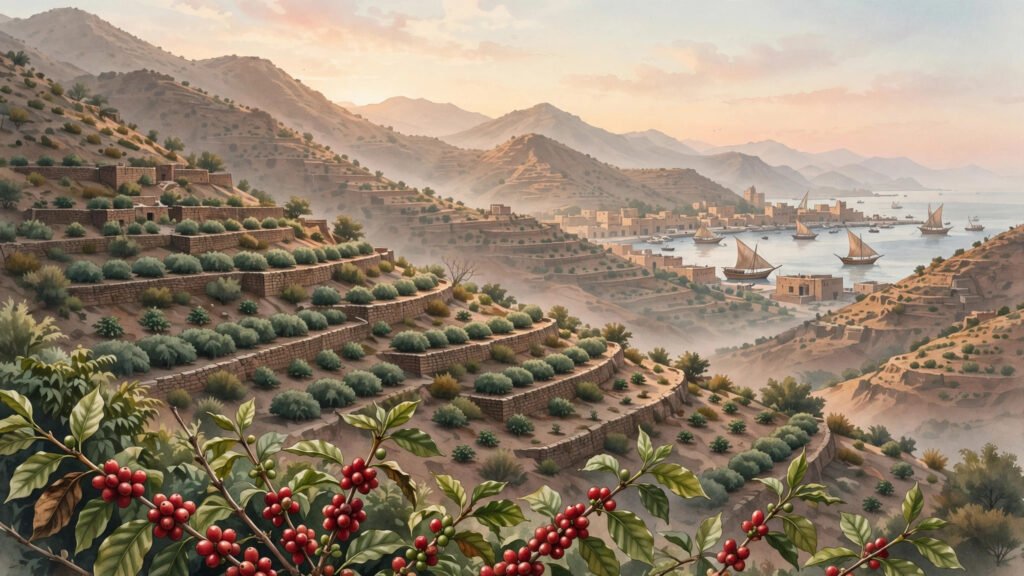
Where did coffee come from? Coffee began in the highlands of Ethiopia, where the wild Coffea arabica plant grew, and was first deliberately cultivated and brewed in Yemen in the 1400s, where Sufi monks drank it to stay awake through night prayers. From Yemen's port of Mocha it spread across the Ottoman world and then to Europe.
That short answer hides a wonderful problem: the most famous part of coffee's story — the goatherd and his dancing goats — is almost certainly a legend, while the true story, pieced together from botany, trade records, and the writings of travellers, is stranger and more interesting. Coffee did not arrive in the world as a drink at all. It arrived as a fruit, eaten raw, chewed, mixed with fat, and only much later roasted, ground, and brewed into the dark cup we know today.
Who was Kaldi, the goatherd with the dancing goats?
Every coffee origin story starts with Kaldi, so let us tell it properly — and then mark it for what it is. Around the 9th century, so the tale goes, an Ethiopian goatherd named Kaldi noticed his goats behaving oddly after nibbling bright red cherries from a bush: they danced, skipped, and stayed awake all night. Curious, Kaldi tried the cherries himself, felt the same buzz of energy, and carried them to a nearby monastery. The monks there, unimpressed at first, supposedly threw the cherries into a fire — and the roasting beans released an aroma so inviting that they fished them from the embers, ground them, and brewed the first cup.
It is a perfect story, which is exactly why historians are suspicious of it. No written version of the Kaldi legend appears until centuries after the supposed events, and the earliest accounts date from the 1600s, when coffee was already a global commodity in need of a charming backstory. There is no contemporary 9th-century record of Kaldi, and no evidence that anyone in Ethiopia brewed coffee that early. What the legend does preserve, though, is a genuine geographical truth: wild Coffea arabica really does grow in the forests of Ethiopia's Kaffa region — the plant's very name, arabica, and the word "coffee" itself are both tangled up with that place — and Ethiopian people really did know the cherry long before anyone brewed it.
The documented Ethiopian chapter is humbler than the legend. For centuries, people in the region ate the cherry whole, or crushed the beans and mixed them with animal fat into energy balls — a portable food for travellers and warriors, not a morning ritual. The leap from food to drink happened elsewhere.
How did Yemen turn a cherry into a drink?
The first credible evidence of coffee as a brewed drink comes from Yemen in the 15th century, and it comes with a religious motive. Sufi monks in Yemen drank a hot infusion of coffee — then called qahwah, an Arabic word that had earlier meant wine — to stay alert during long nights of prayer and chanting. The drink worked, and the practice spread from monastery to monastery, then to the wider population.
Yemen is where coffee growing became farming rather than foraging. The terraced mountainsides around the Yemeni highlands were planted with coffee trees, and the beans were dried, traded, and shipped through the Red Sea port of Mokha — better known in English as Mocha, the name that still survives on café menus today. For more than a century, Yemen held a near-monopoly on the world's coffee trade: every bean that reached Mecca, Cairo, or Istanbul had almost certainly passed through a Yemeni port.
That monopoly also explains the word's journey. Arabic qahwah became Turkish kahve, which became Italian caffè, French café, and finally English "coffee" — a linguistic relay race that maps the drink's route westward almost exactly.
Why did coffeehouses change the world?
From Yemen, coffee travelled with pilgrims and traders to Mecca, where the first coffeehouses — qahveh khaneh — opened. By the mid-1500s they had reached Constantinople, the Ottoman capital, and there they became something new: not just places to drink, but places to talk. Ottoman coffeehouses were called "schools of the wise" — rooms where poets performed, travellers swapped news, and ordinary people debated politics within earshot of the authorities.
The authorities noticed, and they did not always approve. Ottoman rulers periodically tried to ban coffeehouses, suspecting them of fermenting dissent — Sultan Murad IV is said to have gone so far as to patrol Istanbul in disguise and punish coffee drinkers in the 1630s, though the truth of that particular story is as shaky as Kaldi's. What is certain is that the bans failed every time. Coffee was too popular, too profitable, and too woven into daily life to be outlawed.
Europe met coffee through the same trade routes. Venetian merchants brought it from the Ottoman world in the early 1600s, and a famous story — probably embellished — claims that Pope Clement VIII, asked to condemn the "bitter invention of Satan," tasted it and declared it too good to leave to the infidels, effectively baptising the drink for Christian Europe. Whether or not the Pope said it, the sentiment stuck: coffee spread rapidly through Italy, France, and England.
How did coffee reach London — and America?
London's first coffeehouse opened in 1652, run by a Greek servant named Pasqua Rosée, and within a few decades the city had hundreds of them. Each developed its own clientele: merchants, writers, scientists, and stock-traders each had their house. Lloyd's of London, the insurance market, famously began in Edward Lloyd's coffeehouse, where shipowners and insurers met over cups. The coffeehouse was, in effect, the internet of its day — the place where news, gossip, and deals circulated before newspapers did the job.
Coffee reached North America in the 1600s too, carried by Dutch and English colonists, but tea dominated the colonies until the Boston Tea Party of 1773 made tea drinking politically suspect. After that, coffee became the patriotic drink of the new United States — a twist of history that turned a Yemeni Sufi aid to prayer into an American symbol of independence.
The final twist in coffee's origin story is a botanical heist. Yemen's monopoly held until the 1600s and 1700s, when the Dutch smuggled live coffee plants out of Mocha and planted them in Java and Ceylon, and the French carried a single plant to Martinique in the Caribbean — a plant whose descendants, so the story goes, seeded much of Latin American coffee. From one Ethiopian forest, through Yemeni terraces and Ottoman coffeehouses, the cherry had circled the globe.
So where did coffee come from? Not from a single inventor, and not quite from a dancing goat. It came from a wild Ethiopian plant, a Yemeni monastery, and a Red Sea port — and from the talkative rooms that grew up around the cup, which changed how the world did its thinking.
Frequently Asked Questions
Where did coffee originally come from?
Coffee's wild ancestor, Coffea arabica, is native to the highlands of Ethiopia, particularly the Kaffa region. It was first cultivated and brewed as a drink in Yemen in the 15th century, where Sufi monks drank it to stay awake during night prayers.
Is the Kaldi and the dancing goats story true?
Probably not as literal history. The Kaldi legend first appears in writing centuries after the events it describes, and there is no 9th-century record of it. It is best read as a folktale that preserves a real geographical fact: wild coffee grew in Ethiopia, and people there knew the cherry long before brewing began.
Why is coffee called "mocha"?
Mocha (Mokha) was the Yemeni Red Sea port through which nearly all the world's coffee was shipped for over a century. The name stuck to the beans traded there, and later to the chocolate-and-coffee drink, even though modern mocha coffee rarely comes from Yemen.
When did coffee reach Europe?
Venetian traders brought coffee to Europe in the early 1600s, and coffeehouses spread quickly from there — London's first opened in 1652. Coffee reached North America in the 1600s but only overtook tea in the United States after the Boston Tea Party of 1773.





2 thoughts on “Where Did Coffee Come From? The Kaldi Legend and the Road from Yemen”