The Origin of the High Five: Who Slapped First?
 OriginPoint
0
The high five was born on a baseball field in 1977, when Dodgers rookie Glenn Burke raised his hand to Dusty Baker — and Baker slapped it.
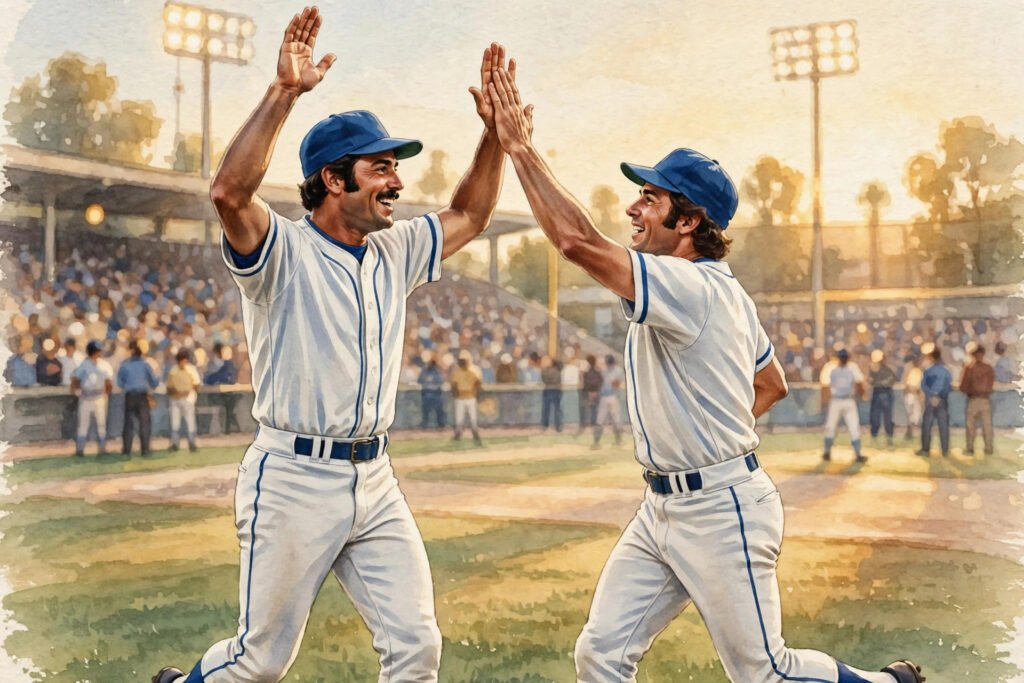
The high five was invented on a baseball field on October 2, 1977, when Los Angeles Dodgers rookie Glenn Burke ran out to congratulate teammate Dusty Baker — who had just hit his 30th home run of the season — and raised his hand high in the air. Baker slapped it. The two men later told the story the same way, and that slap, in the on-deck circle at Dodger Stadium, is the best-documented birth of the most famous gesture in sports.
Two men were there, both told the story, and the date is fixed by the box score. But the high five also has an older ancestor — the low five — and a rival claim from a college basketball team, so the full story is richer than a single slap.
Who invented the high five?
The credit belongs, by the most widely accepted account, to Glenn Burke. The scene was the last game of the 1977 regular season: the Dodgers against the Houston Astros at Dodger Stadium. Dusty Baker came to the plate needing one more home run to reach 30 for the season — a milestone that would make the Dodgers the first team in history with four 30-home-run hitters. He hit it, deep into the stands.
As Baker rounded the bases and headed back toward the dugout, Burke — a 24-year-old rookie outfielder waiting in the on-deck circle — ran toward him with his right hand raised high above his head. Baker, without thinking about it, slapped the upraised hand. It was, by both men’s accounts, pure instinct. Burke later said his hand was up because he was so excited; Baker said he just slapped it because it was there.
Burke told the story in his 1995 autobiography, Out at Home, written with Erik Sherman, and Baker has confirmed it in interviews many times since, always giving Burke the credit. “Glenn Burke invented the high five,” Baker has said plainly. The two men’s accounts agree on the date, the place, and the sequence — which is unusually solid evidence for the origin of a gesture.
What came before the high five — the low five?
The high five did not come out of nowhere. It was a raised version of something older: the low five. “Give me five” and “slap me five” were already well-established phrases in African American slang by the 1920s, part of the language of jazz-age America — a hand slapped palm-to-palm at waist height, a greeting and a mark of agreement.
The low five was a fixture of Black American culture for half a century before Burke raised his hand: a greeting on street corners, in barbershops, and on playgrounds. The number five, of course, is the five fingers of the hand. What Burke did, whether he knew it or not, was lift an old gesture into the air — turning a low, casual greeting into a high, triumphant one, performed at arm’s length above the head where a stadium crowd could see it.
That visibility is one reason the gesture caught on so fast in sports: in a ballpark, a raised hand reads from the cheap seats.
Is there a rival claim to inventing the high five?
There is, and it is worth hearing. Players on the University of Louisville basketball team of the 1978–79 season — among them Darrell Griffith and Derek Smith — have said they were high-fiving each other during that season, and some Louisville accounts credit the team with popularising the gesture in basketball.
The problem for the Louisville claim is the calendar. The Dodgers moment is dated October 2, 1977. The Louisville season began more than a year later, in the autumn of 1978. Even the players who remember the Louisville high fives do not claim to have done it before the Dodgers did — the claim is about who spread it in basketball, not who did it first. The Burke–Baker account is also the earlier one, and the only one with two named witnesses telling the same story on the record.
Scattered claims of earlier high fives exist, but none comes with a date, a place, and two witnesses. In the history of gestures, that is as close to a proven origin as you are likely to get.
How did the high five spread so fast?
The high five spread through American sports in the late 1970s and early 1980s, and then into everyday life. Baseball and basketball players adopted it almost immediately — it was the natural celebration for a home run, a dunk, a big play, performed in full view of the cameras. By 1980 the phrase “high five” was appearing in print, and by the middle of the decade it was everywhere: in schoolyards, in offices, on television.
Television did the heavy lifting: two hands meeting above the head is one of the most photogenic gestures there is, and 1980s films and sitcoms made it a shorthand for triumph. By the 1990s it had crossed the Atlantic and become a global greeting.
It also kept evolving. The “too slow” trick, where one hand is pulled away at the last second; the air five, slapped across a video call; the double high five, both hands at once — each new variation was a reminder that the gesture belonged to everyone now, not just to athletes.
Why did Glenn Burke’s role go unrecognised for so long?
Here the story takes a sadder turn. Glenn Burke was the first Major League Baseball player to come out as gay — he did so after his playing career ended, in 1982 — and he believed, with good reason, that his sexuality shortened his time in the game. He was traded away from the Dodgers in 1978, drifted out of baseball by 1980, and died of AIDS in 1995, at the age of 42.
For years, the high five’s inventor was a footnote, if he was mentioned at all. The gesture was everywhere, but the man who raised his hand first was largely forgotten. It was only later that baseball began to give him his due: in 2014, Major League Baseball honoured him at its first Pride events, and the Dodgers have since recognised his place in the team’s history.
Baker himself has been part of that recognition, repeating the story whenever he is asked and always naming Burke — a reminder that the smallest inventions can outlive their inventors, and that giving credit where it is due sometimes takes decades.
The next time you slap a high five, you are repeating a gesture first performed on a baseball field in October 1977, by a rookie who was simply too happy to keep his hand down.
Frequently Asked Questions
Who invented the high five?
Glenn Burke, a rookie outfielder for the Los Angeles Dodgers, is credited with inventing the high five. On October 2, 1977, after teammate Dusty Baker hit his 30th home run of the season, Burke ran toward him with his hand raised high, and Baker slapped it. Both men told the story the same way, and Baker has always given Burke the credit.
When was the first high five?
The first documented high five took place on October 2, 1977, at Dodger Stadium in Los Angeles, during the last game of the regular season between the Dodgers and the Houston Astros. The phrase “high five” itself first appeared in print around 1980.
What is the difference between a high five and a low five?
The low five is the older gesture: two people slap palms at waist height, a greeting that was part of African American slang as far back as the 1920s (“give me five”). The high five is the same idea raised above the head — more visible, more triumphant, and born on a sports field rather than a street corner.
Did a college basketball team invent the high five?
The University of Louisville basketball team of 1978–79 is sometimes credited with the high five, and its players certainly helped popularise it in basketball. But the Dodgers moment predates the Louisville season by more than a year, so Louisville’s claim is about spreading the gesture, not inventing it.