The Surprising Origin of “Deadline” — From Civil War Prisons to Your Inbox
 OriginPoint
0
The word “deadline” began as a literal line in a Civil War prison camp that prisoners were shot for crossing — here is how it became the office term we use today.
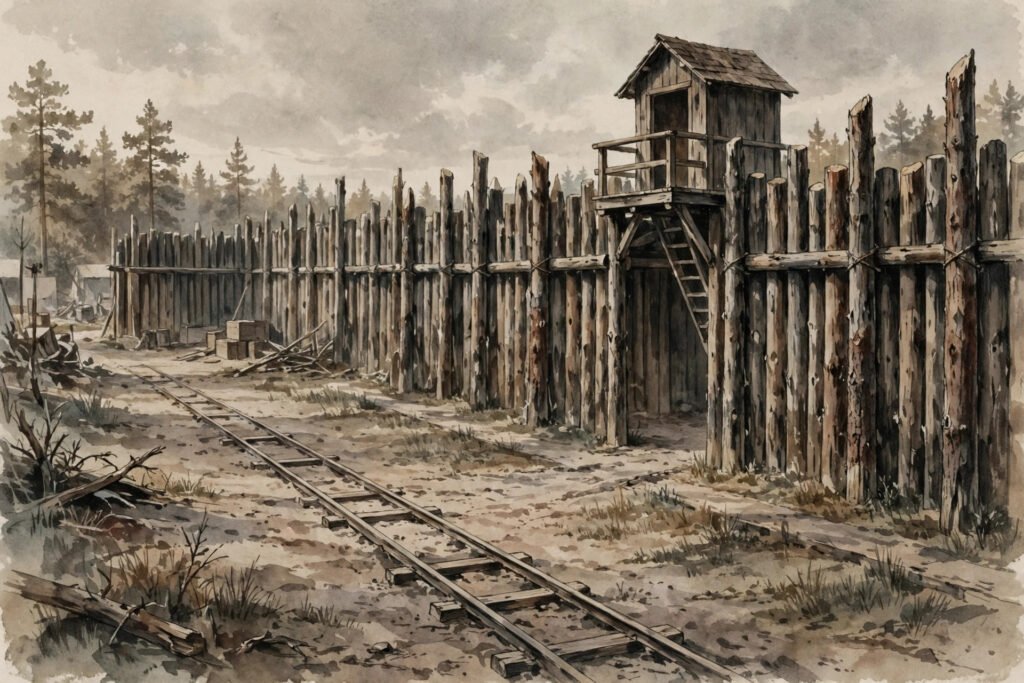
“Deadline” began as a literal line in an American Civil War prison — cross it and you would be shot. The word then vanished for about fifty years, reappeared in newspaper offices around 1920 as the last minute copy could reach the printer, and has meant “time limit” ever since. It is one of the few everyday words that went from a death threat to a diary entry.
What Was the “Dead Line” in a Civil War Prison?
In the summer of 1864, Camp Sumter — better known as Andersonville — held roughly 32,000 Union prisoners in a stockade built for 10,000. The camp sat on about 26 acres of Georgia pine woods, and its walls were pine logs standing roughly 15 feet high. About 19 feet inside that wall ran a second, much slighter barrier: a line of wooden posts connected by a light rail.
That was the dead line.
Guards stationed in the sentry boxes along the wall had standing orders to shoot any prisoner who crossed it. The line existed for a practical reason — to keep prisoners from reaching the wall itself, where they might climb it, dig under it, or grab a guard’s weapon — but the penalty made it terrifying. Prisoners wrote about it in diaries and memoirs: men driven mad by hunger or disease would sometimes walk deliberately toward the line, knowing what would happen.
Andersonville was the most infamous example, but it was not the only one. Dead lines appeared in other Civil War prison camps on both sides, North and South. The term itself is first recorded in print in 1864, in accounts of these camps. The camp’s commandant, Captain Henry Wirz, was later tried by a military commission, and the dead line featured prominently in the testimony against him. Wirz was hanged in Washington on November 10, 1865 — the only Confederate officer executed for war crimes after the war.
How Did a Prison Term Become an Office Word?
The path from prison stockade to newsroom took decades, and it ran through the printing trade. In the late nineteenth and early twentieth centuries, American newspapers were produced on brutal schedules: reporters filed copy, compositors set it in type, and the presses rolled at a fixed hour. Anything that arrived after the presses started was literally dead — it could not appear in that edition.
By the 1920s, newspaper workers were using “deadline” for the last moment copy could be accepted. The Oxford English Dictionary’s early figurative citations come from this newsroom world. The metaphor was a natural one: just as a prisoner could not cross the line, a story could not cross the hour. The line had moved from space to time, but the consequence — exclusion — stayed the same.
The term then spread the way office language spreads: from newspapers to magazines, from magazines to advertising and publishing, and from there into every workplace in the English-speaking world. By the middle of the twentieth century, “deadline” had lost almost all of its original menace. Nobody hearing “the deadline is Friday” pictures a prison camp anymore.
The printing-press “dead line” most people never hear about
Before newspapers gave “deadline” its modern meaning, printers used a “dead line” of their own. When a page was set in type, a line was drawn around the edge of the plate: any type set outside that line would not print. It was dead. The line marked the boundary between what readers would see and what would never reach the page. This printing sense and the prison sense ran side by side in the late 1800s, and both fed the same idea — a hard boundary you could not cross without losing something. When newspaper editors in the 1920s started calling their copy cut-off a “deadline”, they were borrowing a word that already meant “the last line that counts” in two different trades.
The word’s other 19th-century lives — factories and fishing
“Deadline” did not belong only to prisons and printers. In the late 19th and early 20th centuries, factories used “deadline” for an upper age limit for employment — often 35 — set by the employer: past that age, you were not hired. And in fishing, a “dead line” described a slack line in ledgering, where the bait sits on the riverbed and the line goes dead. Neither sense survived, but they show the word was already floating around American English as a general label for an absolute limit long before it settled into the meaning we use today. That is part of why the prison story, dramatic as it is, is probably not the whole story of the modern word.
The fifty-year gap nobody can fully explain
The strange part of “deadline” is the silence. The prison use is documented in the 1860s — in a prisoner’s diary from March 1863, in an inspection report of May 1864, and in the trial of the Andersonville commander Henry Wirz in 1865. Then the word seems to go quiet for roughly fifty years. It reappears in the 1920s in newspaper jargon, meaning the last minute copy can be sent to the printer. Linguists still argue about whether the newspaper use grew out of the prison use or was coined independently by an editor with a morbid sense of humour. The honest answer is that the link is plausible but unproven — and that uncertainty is itself part of the word’s story. What is certain is the date of the modern sense: by 1919–1920 it is in print as newspaper jargon, and from there it spreads to every office in the English-speaking world.
“Dead” + “line”: what the two halves actually mean
“Dead” comes from Old English dēad, from the Proto-Germanic daudaz, rooted in a word meaning to die or cease. By the 1500s it had also picked up the sense of “utter, absolute” — a dead stop, a dead end, a dead certainty. “Line” comes from Latin linea, a linen thread, the thin cord used for measuring straight boundaries. Put together, a “dead line” was never just a line: it was an absolute boundary, a line with no give in it. That is why the word survived when other prison slang died — it named a feeling everyone recognises, the point past which there is no more room.
Why Did “Deadline” Stick When Other Prison Slang Didn’t?
Civil War camps produced plenty of slang, and most of it died with the generation that used it. “Deadline” survived for a simple reason: it was useful. Every industry that works to a schedule needed a single sharp word for “the point after which it is too late,” and “deadline” filled the gap better than anything else.
The word also had a quality that good metaphors share — it was vivid without being obscure. Even people who had never heard of Andersonville could feel what a “dead line” meant: a boundary with consequences. That vividness is why the word later spawned cousins like “drop-dead date” and why it migrated so easily into project management, software development, and school assignments.
There is also a darker reason it stuck around: the Andersonville story refused to fade. The camp became a national symbol of wartime suffering — a National Historic Site today — and Wirz’s trial kept the dead line in the history books. A word tied to a famous atrocity has a way of lodging itself in a language.
Is the Andersonville Story Actually True?
Mostly, yes — but with one correction worth making. Popular retellings often imply that Andersonville invented the dead line. The documented record says otherwise: the practice existed in several camps, and the term appears in accounts from more than one prison. Andersonville’s version was simply the most notorious, because the camp’s death toll — nearly 13,000 of the roughly 45,000 men who passed through it — made everything about it infamous.
Another nuance: historians debate how consistently guards enforced the line and whether every crossing ended in a shooting. Some prisoners who stumbled across it in delirium were reportedly warned off rather than fired on. The rule was real, the shootings were real, and the terror was real — but like most wartime stories, the details varied from day to day and guard to guard. What is not in dispute is the word itself: “dead line” entered American English in 1864, in a prison camp, meaning a boundary you crossed at your peril.
Why the Origin Still Matters
There is a small irony in the word’s journey that is worth sitting with. The original deadline was a line in space, drawn by someone else, enforced by violence. The modern deadline is a line in time, usually drawn by ourselves — or at least by a boss, an editor, or a calendar invite. The fear it produces is far milder, but the structure is identical: a boundary, a consequence, and the knowledge that crossing it changes what happens next.
So the next time a deadline looms over your Friday, remember that it once loomed over something much worse than an inbox. The word survived because the feeling survived: some lines, once crossed, cannot be uncrossed.
Deadline at a Glance: From Prison Line to Office Word
| When | What happened |
|---|---|
| 1864 | The term is first recorded in print, in accounts of Civil War prison camps; Andersonville (Camp Sumter) holds roughly 32,000 Union prisoners in a stockade built for 10,000 |
| 1864–1865 | The dead line, a wooden rail about 19 feet inside the 15-foot stockade wall, features in testimony at the trial of commandant Henry Wirz |
| November 10, 1865 | Wirz is hanged in Washington, the only Confederate officer executed for war crimes after the war |
| 1920s | Newspaper workers use “deadline” for the last moment copy can be accepted before the presses roll |
| Mid-twentieth century | The word spreads from journalism into general office language and loses its original menace |
Related reading: why do we say goodbye, the origin of OK, the origin of the croissant, the origin of quarantine
Frequently Asked Questions
Where did the word “deadline” come from?
“Deadline” comes from the “dead line” of American Civil War prison camps — a marked boundary inside the stockade that prisoners were forbidden to cross on pain of being shot. The term is first recorded in print in 1864.
Which prison camp had the most famous dead line?
Andersonville (Camp Sumter) in Georgia, where about 19 feet inside the stockade wall a wooden rail marked the line. Roughly 32,000 Union prisoners were held there at its peak in August 1864, and nearly 13,000 died in the camp overall.
When did “deadline” start meaning a time limit?
The figurative sense — the last moment work can be submitted — emerged in American newspaper offices in the 1920s, where copy arriving after the presses started could not appear in that edition. From journalism it spread into general office language by the mid-twentieth century.
Was Captain Henry Wirz executed because of the dead line?
The dead line was part of the case against him, but not the whole of it. Wirz, Andersonville’s commandant, was convicted by a military commission of conspiracy and murder and hanged on November 10, 1865 — the only Confederate officer executed for war crimes after the Civil War.
Why did the word disappear for fifty years?
Nobody knows for certain. After the Civil War trials, “deadline” fades from print until the 1920s, when newspaper editors start using it for the copy cut-off. It may have survived in spoken use, or the newspaper sense may have been coined afresh. Either way, the gap is real — and it is why careful dictionaries say the modern sense was “perhaps influenced by” the prison use rather than directly descended from it.
Is the printing-press “dead line” the same thing?
It is a cousin, not the same thing. In printing, the “dead line” was the edge of the plate: type outside it would not print. It shared the same idea — a boundary past which something is lost — and it was in use around the same time as the prison sense. Both probably fed the word’s later meaning.
Did factories and fishermen use “deadline” too?
Yes — in the late 19th and early 20th centuries, some factories used “deadline” for an upper age limit for hiring, often around 35, and fishermen used “dead line” for a slack line in ledgering, where the bait sits on the riverbed. Neither sense survived, but both show the word already meant an absolute limit in American English long before it settled into “time limit”.
What does “dead” mean in “deadline”?
“Dead” comes from Old English dēad, and by the 1500s it had also picked up the sense of “utter, absolute” — a dead stop, a dead end, a dead certainty. “Line” comes from Latin linea, a linen thread used for measuring straight boundaries. A “dead line” was never just a line: it was an absolute boundary, a line with no give in it.