Where Did the Christmas Tree Come From? Germany’s Gift to the Holidays
 OriginPoint
0
The Christmas tree began in 16th-century Germany, where families in Strasbourg brought fir trees indoors and decorated them with apples, paper roses, and candles — and it took a royal engraving, two ocean crossings, and a German song to make it a global tradition.
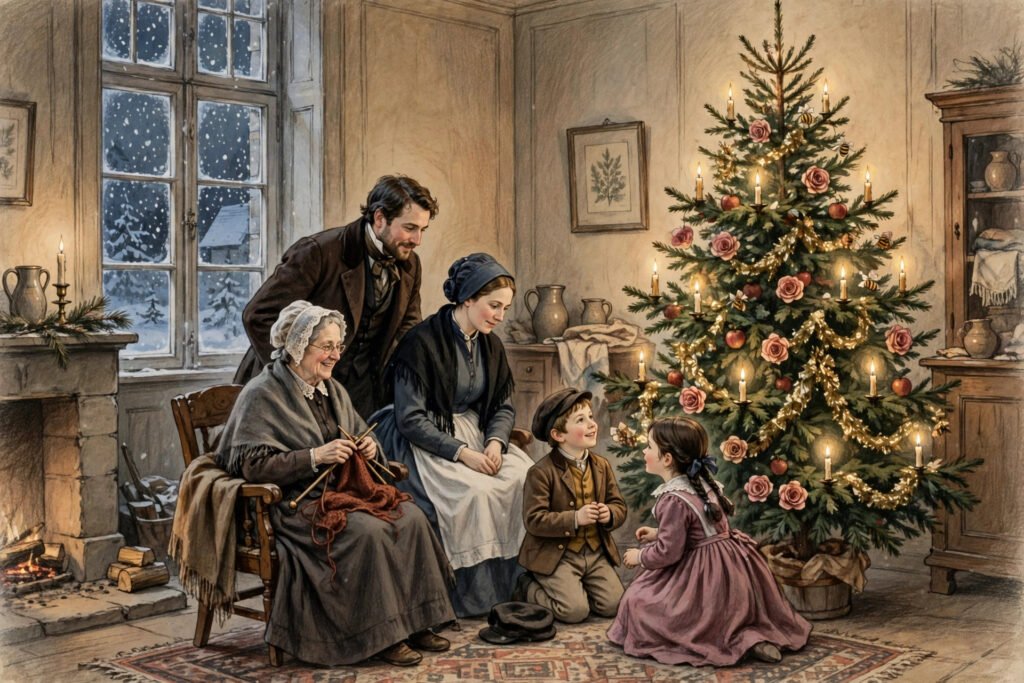
The Christmas tree comes from 16th-century Germany, where families in Strasbourg and the Alsace region began bringing fir trees indoors at Christmas and decorating them with apples, paper roses, and candles. The custom spread through northern Europe, reached Britain through Prince Albert, and arrived in America with German settlers — becoming, in about three centuries, the world’s best-known Christmas symbol.
Did people decorate evergreens before Christmas trees existed?
Yes, and this is where the story often gets told wrong. Long before anyone put a tree in a living room, people in the northern winter brought evergreen branches indoors as a sign that life would return. The Egyptians carried green palm rushes into their homes to honour Ra, the sun god. The Romans decorated their houses with evergreen boughs during Saturnalia, the mid-December festival. Germanic peoples used fir branches in winter-solstice celebrations.
These were all real customs, and they help explain why the fir felt right as a Christmas symbol. But none of them was a Christmas tree. A branch on a wall is not a tree standing in a room. The Christmas tree has its own, much more recent beginning — in the towns of the German Rhineland, in the 1500s.
When did the first Christmas tree appear?
The first Christmas trees were public, not domestic — and two Baltic cities still argue over which of them was first. In Riga, in what is now Latvia, the Brotherhood of the Blackheads, a guild of unmarried merchants, is recorded as having decorated a tree in the town square in 1510, and then setting it alight. Tallinn, in Estonia, claims an even earlier tree in 1441, set up by the same brotherhood.
The household tree — the one we recognise — appears a little later, in Strasbourg. One of the earliest records comes from the city in 1539, when a tree was set up in the cathedral. By 1605, a Strasbourg chronicle was describing trees decorated in people’s homes with paper roses, apples, wafers, and gilded sugar. In 1611, Duchess Dorothea Sibylle of Silesia had a tree decorated with candles — the earliest recorded candle-lit tree in a home.
Did Martin Luther really invent the Christmas tree?
The best-known story about the tree’s origin is also its least reliable. According to the legend, Martin Luther was walking home through the woods on a winter’s night in the 1500s, saw the stars shining through the branches of a fir, and was so struck that he brought a tree indoors, set candles on its branches, and told his family he was recreating what he had seen.
It is a lovely story, and it is almost certainly not true. There is no contemporary evidence for it; the first versions of the tale appear in the 19th century, three hundred years after Luther’s death. Luther may well have had a tree in his home — the custom was spreading in his lifetime — but the starry-night epiphany is a Victorian invention. What the legend does get right is the candles: by the early 1600s, Germans really were putting candles on their trees.
How did the Christmas tree reach England?
It arrived twice. The first time, almost nobody noticed. In 1800, Queen Charlotte, the German-born wife of George III, put up a decorated tree at Windsor for a children’s party — the first recorded Christmas tree at the English court. The custom stayed a German royal quirk for another half-century.
The second arrival was the one that mattered. In December 1848, the Illustrated London News printed an engraving of Queen Victoria, Prince Albert, and their children standing around a decorated tree at Windsor Castle. Albert, who had grown up with the custom in Saxe-Coburg and Gotha, had made the tree a fixture of the royal Christmas. The image was printed, copied, and talked about everywhere — and suddenly every respectable household in Britain wanted a tree of its own. Two years later, the American magazine Godey’s Lady’s Book reprinted the picture (quietly removing the Queen’s tiara and the Prince’s moustache, so the family looked like ordinary Americans), and the tree took off in the United States too.
When did the Christmas tree arrive in America?
German settlers had brought the tree with them long before the royal engraving. Moravian settlers in Bethlehem, Pennsylvania, were decorating trees in the 1740s, and German communities in Pennsylvania kept the custom alive through the 18th century. In 1832, Charles Follen, a German immigrant and Harvard professor, set up a decorated tree in his home in Cambridge, Massachusetts — often called the first public display of a Christmas tree in America.
But like Britain, America only adopted the tree widely after the royal picture circulated. President Franklin Pierce put the first tree in the White House in 1856, and by the 1870s the decorated fir was a normal part of an American Christmas.
Where did the ornaments and lights come from?
The first decorations were edible, and they carried meaning. The apples on early German trees recalled the paradise tree of medieval mystery plays — a fir hung with apples represented the Tree of Knowledge, and the wafers stood for the bread of the Eucharist.
Glass ornaments came from Lauscha, a town in Thuringia, Germany, where glassblowers began making blown-glass baubles in the 1840s and 1850s — Hans Greiner is credited with the first glass tree ornaments, blown in the shape of fruit and nuts. Tinsel is older still: it was invented in Nuremberg in the 1600s, when silversmiths hammered silver into thin strips to catch the candlelight. Electric lights arrived in 1882, when Edward Johnson — an associate of Thomas Edison — put 80 small red, white, and blue electric bulbs on a tree in his New York home. It took decades for electric lights to become affordable, but Johnson’s tree was the beginning of the end for candles — and for the Christmas tree fires that had plagued the 19th century.
Why do Germans call it the Tannenbaum?
The German word for the tree is Tannenbaum — fir tree — and the song “O Tannenbaum” did as much as any royal engraving to fix the fir as the Christmas tree. The melody is an old folk song, and Ernst Anschütz wrote the familiar words in 1824. The song is not really about Christmas at all: it praises the fir for staying green through the winter. But it became the tree’s anthem, sung in German homes and then translated around the world.
So where did the Christmas tree come from? From 16th-century German towns, where families decorated a fir with apples and candles; from a Baltic guild’s public tree; from a queen’s drawing room and a magazine engraving that turned a royal habit into a fashion; and from German immigrants who carried it to America. Like the story of Halloween, another winter festival that crossed an ocean and changed its meaning on the way, the Christmas tree is proof that traditions travel — and that a good idea, once decorated, is hard to stop.
Frequently Asked Questions
Where did the Christmas tree originate?
The Christmas tree originated in 16th-century Germany. The earliest household trees are documented in Strasbourg, where a 1605 chronicle describes trees decorated with paper roses, apples, wafers, and sugar. Earlier public trees are recorded in Riga in 1510 and Tallinn in 1441.
When was the first Christmas tree?
The first documented Christmas trees appeared in the early 1500s: a guild tree in Riga in 1510, and possibly one in Tallinn in 1441. The first decorated household trees appear in Strasbourg records from 1539 onwards, with a detailed description in 1605.
Who brought the Christmas tree to England?
Prince Albert brought the Christmas tree into the British royal household, and the December 1848 engraving in the Illustrated London News of the royal family around their tree at Windsor made the custom fashionable across Britain. Queen Charlotte had put up a tree at Windsor as early as 1800, but it did not catch on then.
When did the Christmas tree come to America?
German settlers brought the Christmas tree to America in the 1700s — Moravian settlers in Bethlehem, Pennsylvania, decorated trees in the 1740s. It became widespread after 1850, when Godey’s Lady’s Book reprinted the royal family’s tree engraving; the first White House tree followed in 1856.