Who Really Invented the Light Bulb? Edison vs. Swan and the Fight for the Glow
 OriginPoint
1
The light bulb has two fathers — Joseph Swan lit his house with one a year before Edison’s famous test, but Edison built the system that put bulbs in every home. The real story is a race, a lawsuit, and a merger.
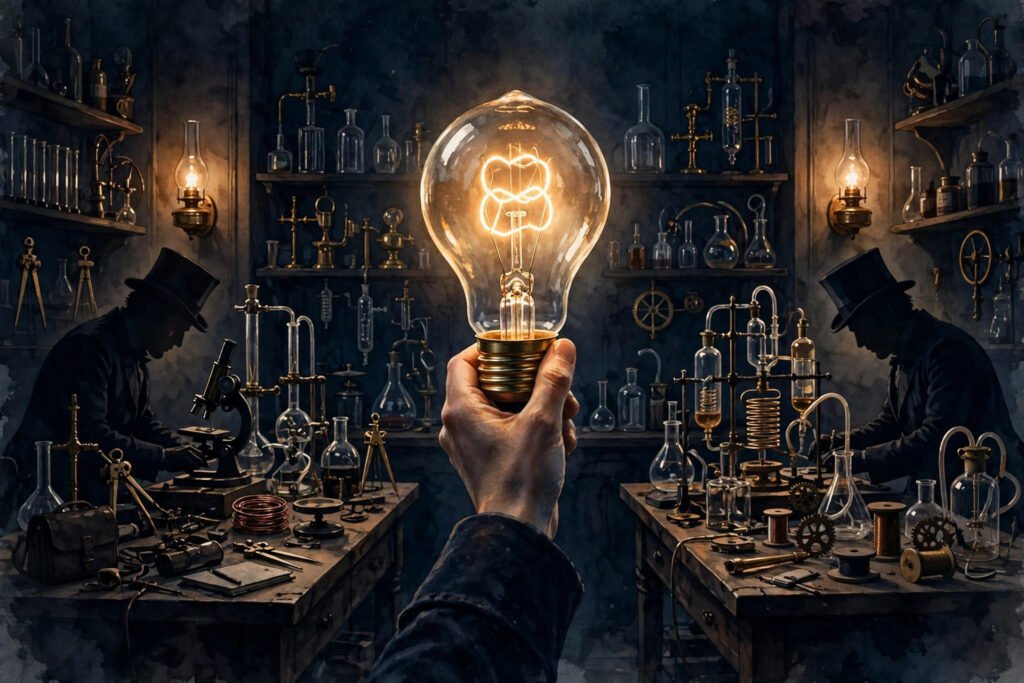
Ask who invented the light bulb and most people say Thomas Edison — but the honest answer is that no single person did. Joseph Swan demonstrated a working incandescent bulb in December 1878, nearly a year before Edison’s October 1879 test. Edison won the history books by turning the bulb into a business: filaments, generators, wiring, and the first power grid.
Who Invented the Light Bulb First?
The question of who invented the light bulb has a trick inside it: it depends on what “invented” means. If it means the first person to make a glowing wire in a glass bulb, the answer reaches back to 1802, when the Cornish chemist Humphry Davy passed an electric current through a strip of platinum and watched it glow white-hot. By 1806 he was demonstrating a blazing carbon arc lamp to the Royal Institution in London. Davy’s lamps were far too bright, too hot, and too short-lived for a living room, but the principle — a filament heated until it shines — was established seventy years before Edison.
Dozens of inventors then chased the same problem: a filament that glowed brightly without burning out, inside a bulb with the air pumped out so the filament could not oxidise. In 1840, the astronomer Warren de la Rue built a platinum-coil bulb inside a vacuum tube. It worked beautifully and cost a fortune — platinum was far too expensive for a household lamp. The search turned to carbon, the one material that could survive white heat without melting.
Who Was Joseph Swan, and Why Does History Forget Him?
Joseph Wilson Swan was a chemist and photographer from Sunderland, in the north-east of England. He had been experimenting with electric light since the 1850s, and in 1860 he built an early incandescent lamp using a carbonised paper filament inside an evacuated glass bulb. It glowed, but only briefly — the vacuum pumps of the day could not remove enough air, and the filament blackened and died.
Swan kept at it. By 1878 he had a better vacuum pump and a better filament: cotton thread, carbonised until it was pure carbon. On 18 December 1878, he demonstrated his lamp before the Literary and Philosophical Society of Newcastle upon Tyne — a public, working incandescent bulb, months before Edison’s team had anything comparable. In February 1879 he gave a second lecture-demonstration, and by the end of that year his own house at Low Fell, Gateshead, was lit by Swan lamps — the first private home in the world lit by incandescent electric light.
Swan was not a showman, and that cost him. He published, he patented, he founded the Swan Electric Light Company in 1880, and in September 1881 his lamps lit the Savoy Theatre in London — the first public building in the world lit entirely by electricity. But he never built the machinery of a mass market. Edison did.
What Did Edison Actually Invent?
Thomas Edison’s famous test at Menlo Park, New Jersey, took place on 21–22 October 1879, when a lamp with a carbonised cotton-thread filament burned for about thirteen and a half hours. Edison’s team then tested thousands of materials — the “filament hunt” is real, and the lab notebooks prove it — before settling on carbonised bamboo, which in January 1880 burned for around 1,200 hours in testing. Edison received US Patent 223,898 for his electric lamp on 27 January 1880.
But Edison’s true invention was not the bulb. It was the system around it. Swan had a lamp; Edison built the world the lamp needed: dynamos to generate the power, a distribution network to carry it, meters to bill for it, switches and sockets to use it, and a company to sell it all. On 4 September 1882, Edison’s Pearl Street Station in New York switched on the first commercial central power station, lighting 85 customers’ premises in lower Manhattan. A bulb you cannot buy, power, or plug in is a curiosity; Edison made it a utility.
There is also a name the Edison story usually leaves out. Lewis Howard Latimer, a Black inventor and draughtsman who joined Edison’s company in 1884, had patented an improved process for manufacturing carbon filaments in 1881 (US Patent 252,386) and later wrote the first textbook on electric lighting. The filament that made Edison’s lamps commercially reliable owed a great deal to Latimer’s work.
Edison vs. Swan: The Patent War That Ended in a Handshake
Edison and Swan were bound to collide. Edison’s company sued Swan in Britain in 1882, claiming his lamp infringed Edison’s patent. The case never reached a verdict. Swan’s prior work was strong — he could show lamps, lectures, and a lit house predating Edison’s patent — and Edison’s lawyers could show a patent that a British court was likely to uphold. Both sides had more to lose than to gain.
In 1883 they settled, and the settlement was a merger: the Edison & Swan United Electric Light Company, quickly nicknamed “Ediswan.” Edison took the American market, Swan the British, and both men kept making bulbs — together. The two rivals ended up as business partners, and the company they formed supplied lamps in Britain for decades. It is a rare patent war with a genuinely happy ending, and it is also the reason the question “who invented the light bulb” has no single name on it.
So Who Gets the Credit?
Here is the fairest verdict the record supports. Humphry Davy proved the principle in 1802. Joseph Swan built the first practical incandescent lamp and demonstrated it publicly in 1878, a year before Edison. Thomas Edison made the first commercially successful lamp and, more importantly, built the electrical system that put it in homes and streets. Neither man invented the light bulb alone; each solved a different piece of the puzzle, and the bulb we use today descends from both of them.
The reason Edison’s name stuck is not a conspiracy — it is the difference between an invention and an industry. Swan invented a lamp. Edison invented an industry that needed a lamp. The next time you flick a switch, the glow above you owes something to a quiet chemist in Newcastle and a relentless showman in New Jersey, and to the lawsuit that turned them into partners.
Frequently Asked Questions
Who invented the light bulb?
No single person. Humphry Davy demonstrated the principle in 1802, Joseph Swan built the first practical incandescent lamp and demonstrated it publicly in December 1878, and Thomas Edison patented a commercially successful version in 1880 and built the power system around it. Swan had the working bulb first; Edison made it a business.
When was the light bulb invented?
The first practical incandescent lamps appeared in 1878–1879: Swan’s public demonstration in December 1878 and Edison’s long-burning test in October 1879. The first commercial electric lighting system followed in 1882 with Edison’s Pearl Street Station in New York.
Did Edison steal the light bulb from Swan?
No. Edison developed his lamp independently at Menlo Park, but Swan had demonstrated a working lamp earlier. Edison’s company sued Swan in Britain in 1882; the two settled in 1883 by merging into the Edison & Swan United Electric Light Company (“Ediswan”).
What was the first light bulb made of?
Early successful bulbs used a carbonised filament — cotton thread or bamboo, heated until it was pure carbon — sealed inside a glass bulb with the air pumped out. The vacuum stopped the carbon from burning away, letting it glow for hundreds of hours.





1 thought on “Who Really Invented the Light Bulb? Edison vs. Swan and the Fight for the Glow”