The Origin of the Escalator: From a Coney Island Ride to Every Shopping Mall
 OriginPoint
0
The escalator began as a fairground ride at Coney Island in 1896 — Jesse Reno’s moving belt carried 75,000 thrill-seekers seven feet up before Charles Seeberger gave it steps, a name, and a home in the world’s department stores.
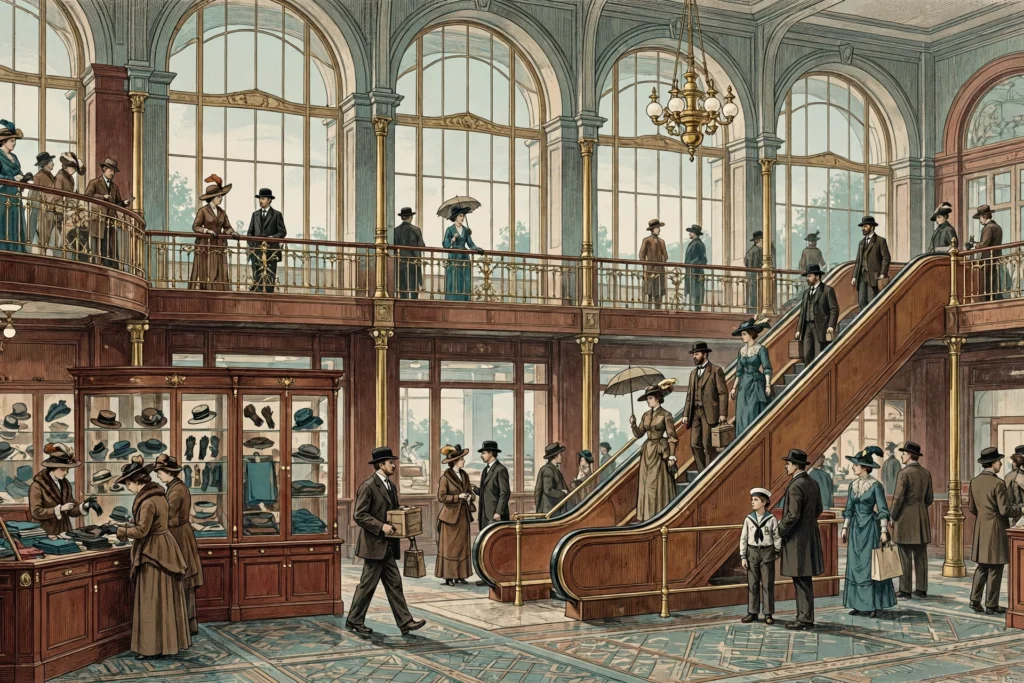
The origin of the escalator lies in 1890s America. Jesse Reno patented a moving inclined belt in 1892 and showed it as a fairground ride at Coney Island in 1896, carrying 75,000 riders up seven feet. Charles Seeberger built the stepped version, coined the name “escalator” in 1900, and with Otis took it into department stores and the Paris Exposition.
Who Patented the First Escalator?
The origin of the escalator begins not with a staircase, but with a patent for one that nobody built. In 1859, Nathan Ames of Saugus, Massachusetts, patented what he called “revolving stairs” — steps arranged on an endless inclined belt, recognisably an escalator on paper. Ames never built one, and the idea languished for thirty years. In 1889, Leamon Souder of Philadelphia patented a similar stairway design; his, too, remained unbuilt.
The first working escalator came from Jesse Wilford Reno, a mining and metallurgical engineer from Lehigh University. Reno had been thinking about underground transport in New York — a double-decker subway — and needed a way to move crowds between street level and the platforms without the delays of a vertical lift. His answer was an “endless conveyor or elevator”: a belt of cleated metal planks set at a 25-degree incline, with comb-like teeth at the landings and a handrail that moved along with the belt. He received US Patent No. 470,918 for it on 15 March 1892.
Reno’s machine had no individual steps — passengers simply stood on a moving belt, like a treadmill tilted uphill. But it already carried two features every modern escalator still has: the serrated landing plates and the moving handrail. Reno also proposed the pairing we now take for granted: one machine up, another down.
Why Was the First Escalator a Fairground Ride?
If you invent a machine for moving crowds and nobody will buy one, you do what showmen have always done: you charge people to ride it for fun. In 1896, Reno installed his inclined elevator as an amusement attraction at the Old Iron Pier on Coney Island, New York.
For two weeks, visitors queued to be carried seven feet into the air on a moving belt — a ride so short it would barely clear a modern ceiling. Around 75,000 people rode it, at about 75 feet per minute, according to Guinness World Records. A contemporary report in the 1896 Street Railway Review praised its capacity — a single narrow machine could move 3,000 people an hour — and noted that it needed no attendant at all.
The ride was, in truth, a sales demonstration dressed up as entertainment. Reno had installed it to impress the trustees of the Brooklyn Bridge, the officers of the elevated railways, and the Boston subway — the people who might buy his machine for real stations. After Coney Island, the machine moved to the Manhattan side of the Brooklyn Bridge, where it kept working as a working exhibit. The fairground ride had proved the idea; what it had not yet proved was that ordinary people would trust it in a shop.
What Is the Origin of the Escalator’s Name?
While Reno was running his ride at Coney Island, another inventor was solving the escalator’s remaining problem: the belt. Standing on a moving slope is unnerving; standing on flat steps that form themselves as you ride is natural. Charles Seeberger, working in the mid-1890s, bought the patent of George A. Wheeler — whose design was closer to a true staircase — and in 1897 redesigned the machine around flat, interlocking steps.
Seeberger also gave the machine its name. In 1895, his legal counsel had advised him to name his invention. By his own account, he took “scala” — Latin for steps — as the root, added “E” as a prefix and “Tor” as a suffix, and produced “escalator,” meaning “a means of traversing from.” Other accounts point to the French escalade, a climb over a wall. Either way, the word was his.
Seeberger partnered with the Otis Elevator Company, and together they built the first commercial escalator in 1899 at the Otis factory in Yonkers, New York. A year later, the Seeberger–Otis wooden escalator won first prize at the 1900 Paris Exposition. It was the first time the device was called an escalator in public, and the name stuck.
How Did the Escalator Conquer the Department Store?
Department stores were the escalator’s first true home, and they adopted it with remarkable speed. London’s Harrods began operating escalators in 1898, and the story goes that nervous shoppers were met at the top with smelling salts and cognac to steady their nerves — a reminder of how strange the machine still seemed. In New York, Macy’s installed wooden escalators in 1902; remarkably, some of those wooden machines still carry shoppers at the Herald Square store today, making them the oldest escalators in continuous use anywhere in the world.
The machine’s spread was driven by a simple commercial logic: an escalator moves shoppers past merchandise. A lift hides customers inside a box; a staircase tires them; an escalator carries them slowly past every floor’s displays, and it never makes them wait. By the 1920s, Otis engineers led by David Lindquist had combined the Reno and Seeberger designs into the cleated, level steps of the modern escalator — the machine we still ride today.
Transit systems followed the shops. The London Underground installed its first escalators at Earl’s Court station in 1911, and within a generation the moving staircase had become the standard way to move crowds through stations, airports, and stadiums.
Why Isn’t “Escalator” a Trademark Anymore?
Here is the twist in the escalator’s story: its name was once private property. Otis trademarked “Escalator” in 1900, bought Seeberger’s patent rights in 1910, and acquired Reno’s patent the following year. For half a century, “Escalator” with a capital E belonged to one company — and every other maker had to call their machine something else.
Otis’s success undid its own trademark. The word became so universal that the public used it for every moving staircase, whatever its maker. In 1950, the landmark case Haughton Elevator Co. v. Seeberger ended the matter: the United States Patent Office ruled that “escalator” had become a common descriptive term for moving stairways, and the trademark was cancelled. The word lost its capital E and entered the public domain — a textbook case of “genericide,” a brand becoming a victim of its own success. The machine even gave English a new verb: “escalate,” first recorded in 1922 as “to travel on an escalator,” before it took on its modern sense of intensifying step by step.
The origin of the escalator is, in the end, a story about how the most familiar things get their start in the strangest places: a subway plan that never happened, a fairground ride seven feet high, and a made-up word from a Latin dictionary. The next time you step onto a moving staircase without thinking about it at all, you are riding the last survivor of all three.
Frequently Asked Questions
Who invented the escalator?
No single person. Nathan Ames patented the idea of “revolving stairs” in 1859 but never built one. Jesse Reno built the first working machine, patented in 1892 and shown at Coney Island in 1896. Charles Seeberger gave it flat steps and its name in 1900. The modern escalator is a combination of Reno’s and Seeberger’s designs, merged by Otis engineers in the 1920s.
When was the first escalator built?
Reno’s inclined elevator was built and demonstrated as a ride at Coney Island’s Old Iron Pier in 1896, carrying about 75,000 passengers in two weeks. The first stepped escalator, built by Seeberger with the Otis Elevator Company, debuted at the 1900 Paris Exposition.
Where does the word “escalator” come from?
Charles Seeberger coined it in 1900. By his own account he built it from “scala,” the Latin word for steps, with “E” as a prefix and “Tor” as a suffix. Some accounts suggest the French word “escalade” (a climb over a wall) also influenced it.
What is the oldest escalator still in use?
The wooden escalators at Macy’s Herald Square store in New York City, installed in 1902 and still in daily service — the oldest continuously used escalator system in the world.