Where Was Pizza Born? Naples and the Dish That Traveled the World
 OriginPoint
0
Pizza was born in Naples, Italy, where working-class bakers turned flatbread, tomato, and mozzarella into a cheap street food in the 1700s and 1800s — before immigrants and soldiers carried it around the world.
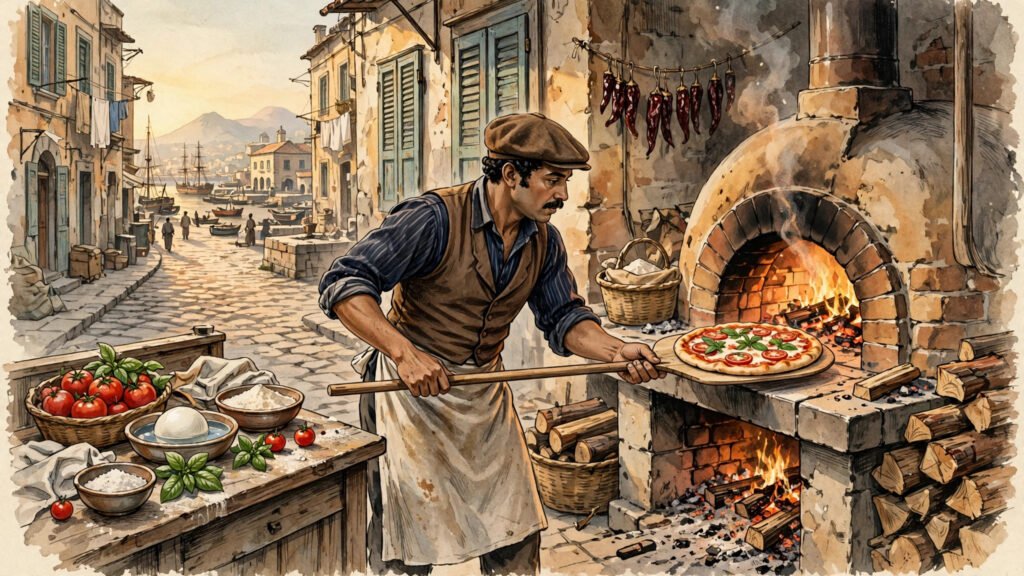
Pizza was born in Naples, Italy. In the 1700s and 1800s, bakers in the crowded port city sold cheap, folded flatbreads topped with tomato, garlic, olive oil, and cheese to dockworkers and labourers who needed a fast, filling meal they could eat with their hands. That working-class street food — not a royal invention, not an ancient recipe — is the direct ancestor of the pizza the whole world eats today.
Where was pizza born, exactly?
The short answer is Naples, in the Campania region of southern Italy, then part of the Kingdom of Naples. But the longer answer matters, because flatbread with toppings is far older than Naples. Egyptians, Greeks, and Romans all baked flat rounds and topped them with oil, herbs, and cheese. Roman soldiers ate a flatbread called placenta, and the Greek pita was a staple of the ancient Mediterranean. None of those was pizza — they lacked the ingredient that defines it.
That ingredient was the tomato, and it arrived from the Americas in the 1500s. For a long time, Europeans in the north treated the tomato with suspicion, believing it poisonous because it belonged to the nightshade family and because aristocrats ate off pewter plates that leached lead into acidic food. In Naples, though, the poor had no such luxury of suspicion. By the 1700s, Neapolitans were eating tomatoes with pasta and on flatbread, and the combination stuck.
The word itself is older than the dish we know. The earliest known written use of the word “pizza” appears in a Latin document from Gaeta, a town between Rome and Naples, dated May 997 — a lease that mentions “duodecim pizze,” twelve pizzas, owed to a local bishop each Christmas and Easter. Historians debate exactly what those early pizzas were — probably a flatbread of some kind — but the word was already in use in southern Italy a thousand years ago.
What did the first Naples pizzas look like?
By the late 1700s, pizza in Naples was unmistakably a food of the poor. The city’s lazzaroni — its working poor, porters, and day labourers — bought slices from street vendors and tiny bakeries, folding them like a book to eat on the move. One of the oldest documented varieties is pizza marinara: tomato, garlic, oregano, and olive oil, with no cheese at all. The name, despite the fishy suggestion, comes from the mariners and sailors who ate it — it kept well without cheese, which mattered on ships and long working days.
Another early favourite was pizza with lard, cheese, and basil, and later the combination that would become famous worldwide: tomato, mozzarella, and basil. Mozzarella di bufala, made from water-buffalo milk in the Campania countryside, gave Naples pizzas a creamy richness no other city’s flatbread could match.
Pizza even had its own dedicated shops early on. Antica Pizzeria Port’Alba, in Naples, traces its history to 1738, when it opened as a tavern serving travellers, and by 1830 it was selling pizza in the form we would recognise. It is often described as the world’s first pizzeria — a claim other shops dispute, but the timeline shows how deeply pizza was already woven into Naples daily life by the early 1800s.
In those days, respectable Neapolitans looked down on pizza. Cookbooks for the middle and upper classes ignored it, and the dish was associated with the rough street life of the port. That snobbery would be swept away by a queen.
Did Queen Margherita really inspire the Margherita pizza?
This is pizza’s most famous story, and it is worth telling carefully, because it sits on the line between documented event and polished legend. In June 1889, Queen Margherita of Savoy, wife of King Umberto I, was staying at the royal palace in Naples. According to the traditional account, she grew tired of rich French court cuisine and asked to try the local street food. Raffaele Esposito, the pizzaiolo at Pizzeria Brandi, was summoned to the palace and presented three pizzas. The queen’s favourite combined tomato, mozzarella, and basil — red, white, and green, the colours of the newly unified Italian flag.
Esposito is said to have named the pizza after her, and Pizzeria Brandi still displays a letter of thanks, dated 11 June 1889 and stamped with the royal household’s seal, praising the pizza “Margherita” for its quality. Food historians note that the letter’s authenticity has been questioned — some suspect it is a later embellishment — and that tomato, mozzarella, and basil pizzas almost certainly existed in Naples before 1889. What is not in doubt is the effect: after the royal visit, pizza gained a respectability it had never had. The food of the docks was suddenly fit for a queen, and the Margherita became Naples’ signature pizza.
Here is the surprising verified detail that undercuts the simple royal fairytale: pizza did not become respectable because a queen tasted it once. It became respectable because Naples itself was changing. As the city modernised and its middle class grew, a dish that had fed the poor for a century was finally claimed as a point of civic pride — and the Margherita story, true in its broad strokes even if polished in its retelling, gave that pride a perfect emblem.
How did pizza travel from Naples to the world?
Pizza left Naples in two great waves: with emigrants, and with soldiers. In the late 1800s and early 1900s, millions of southern Italians emigrated to the Americas, and Neapolitan pizzaioli went with them. In 1905, Gennaro Lombardi, an immigrant from Naples, opened Lombardi’s in New York City — recognised as the first licensed pizzeria in the United States. Its coal-fired oven and thin, Neapolitan-style pies set the template for American pizza, which then diverged into New York slices, Chicago deep-dish, and countless regional styles.
The second wave came after the Second World War. Allied soldiers stationed in Italy during the war had eaten pizza in Naples and Rome and came home craving it. Pizzerias opened across the United States in the late 1940s and 1950s, and American chains then exported the dish back across the globe — including, ironically, back to Italy, where American-style pizza now sits alongside the Neapolitan original.
Naples has guarded its creation ever since. In 2009, the European Union granted Neapolitan pizza Traditional Speciality Guaranteed status, setting rules for a true Pizza Napoletana: a soft, thin centre, a puffy raised edge called the cornicione, San Marzano tomatoes, and fior di latte or buffalo mozzarella, cooked fast in a wood-fired oven at around 430–480°C. And in December 2017, UNESCO inscribed the art of the Neapolitan pizzaiuolo — the pizza maker — on its Representative List of the Intangible Cultural Heritage of Humanity, recognising pizza-making as a living Neapolitan craft, not just a recipe.
So where was pizza born? Not in ancient Rome, not in a royal palace, and not in America. It was born in the streets of Naples, among workers who needed cheap food fast, from a tomato the rest of Europe distrusted and a flatbread the Mediterranean had eaten for centuries. A queen gave it a name and a flag-coloured legend. Emigrants and soldiers gave it the world.
Frequently Asked Questions
Where was pizza born?
Pizza was born in Naples, Italy, in the 1700s and 1800s, where bakers sold cheap flatbreads topped with tomato, garlic, olive oil, and cheese to the city’s working poor. Ancient flatbreads existed earlier, but Naples is where pizza as we know it took shape.
Who invented pizza?
No single person invented pizza. It grew out of Naples street food over decades, shaped by many anonymous bakers. Raffaele Esposito of Pizzeria Brandi is famous for the Margherita pizza he presented to Queen Margherita in 1889, but he refined an existing dish rather than inventing pizza itself.
When was the first pizzeria?
Antica Pizzeria Port’Alba in Naples, founded as a tavern in 1738 and selling pizza by 1830, is often described as the world’s first pizzeria. In the United States, the first licensed pizzeria was Lombardi’s in New York City, opened in 1905 by Neapolitan immigrant Gennaro Lombardi.
Why is the Margherita pizza red, white, and green?
The Margherita’s tomato, mozzarella, and basil match the colours of the Italian flag — red, white, and green. According to tradition, Raffaele Esposito chose those toppings for Queen Margherita in 1889 to honour the newly unified Italy, and the pizza was named after her.


