Who Invented the Zipper? Judson, Sundback, and the “Hookless” Fastener
 OriginPoint
2
The zipper was not invented in one flash of genius — it took a frustrated boot-wearer, a Swedish engineer, and a rubber company naming a boot after a sound.
Who invented the zipper? No single person did. Chicago inventor Whitcomb Judson patented the first clasp-locker fastener in 1893, but it jammed, popped open, and barely sold. The zipper we actually use was created by Swedish-American engineer Gideon Sundback, whose “Hookless No. 2” design of 1913 replaced hooks and eyes with two rows of interlocking teeth — and the word “zipper” itself came later, in 1923, when the B.F. Goodrich Company put that fastener on rubber galoshes and named it for the sound it made.
Why Did Anyone Need a Zipper in the First Place?
It is hard to remember now, but fastening clothes used to be slow, fiddly work. In the late nineteenth century, fashionable boots fastened with a long row of small buttons, done up one by one with a buttonhook. Laces were no faster. For anyone in a hurry — or anyone with stiff fingers, or a child learning to dress alone — the whole business was an everyday annoyance.
That annoyance is where the zipper begins, and it begins twice. The first attempt came in 1851, when Elias Howe — inventor of the modern lockstitch sewing machine — patented an “Automatic, Continuous Clothing Closure”: clasps joined by a cord that slid up and down on ribs. Howe never built it, and the idea sat untouched for forty years.
The man who picked it up was Whitcomb L. Judson, a Chicago mechanical engineer and salesman. Judson was, by his own account, tired of fastening his high-button boots. After two years of drawings, he was granted US patents 504037 and 504038 on 29 August 1893 for a “Clasp Locker or Unlocker for Shoes”: hooks and eyes on two fabric strips, pulled together one pair at a time by a sliding guide.
What Went Wrong With Judson’s Clasp Locker?
Judson showed the Clasp Locker at the 1893 World’s Columbian Exposition in Chicago, and the display did its job — it attracted an investor. Colonel Lewis Walker saw the potential, backed Judson, and together they formed the Universal Fastener Company to manufacture it, marketing the improved version as the “Judson C-curity Fastener.”
The product, unfortunately, did not live up to the pitch. The hook-and-eye mechanism was complicated, expensive, and unreliable: sometimes the hooks failed to mesh, sometimes the fastening popped open, sometimes it jammed. It found niches on boots, mailbags, and tobacco pouches, but fashion stayed away — a closure that might burst open in public was not something a tailor wanted to sew into a garment.
Judson kept filing improvements, in 1896 and 1905, but the core problem remained: hooks and eyes pulled together by a slider were the wrong geometry. The fastener needed a different idea entirely.
How Did Gideon Sundback Fix the Zipper?
That someone was Gideon Sundback, born in Sweden in 1880, trained in electrical engineering in Germany, and emigrated to the United States in 1905. After a short spell at Westinghouse, he was hired in 1906 by Judson’s company — by then reorganised as the Automatic Hook and Eye Company — as head designer. His first project, the “Plako” fastener of 1908, was still a hook-and-eye design, a bridge rather than a breakthrough.
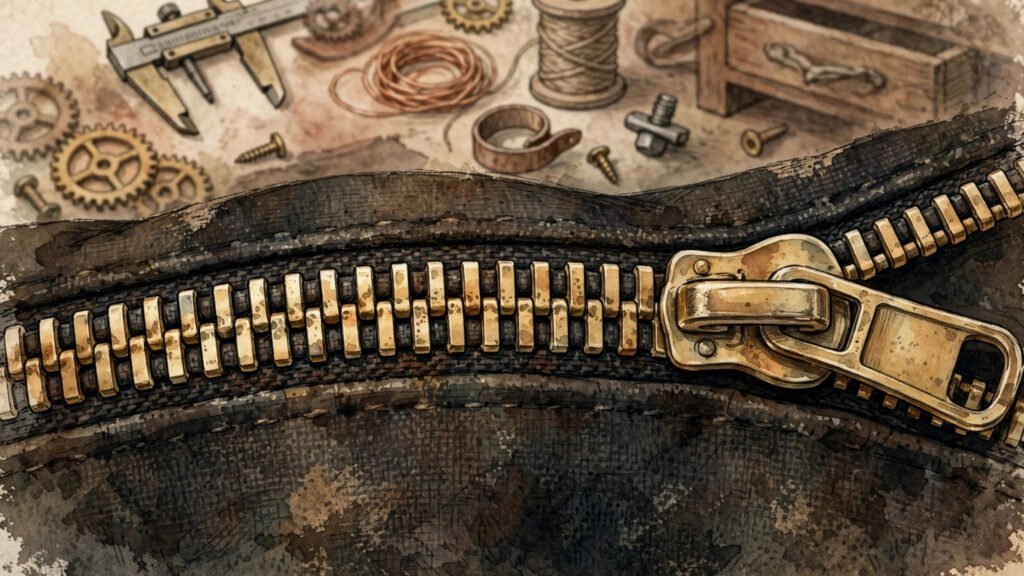
Then Sundback started over. Instead of hooks catching eyes, he designed two facing rows of identical small teeth, each with a tiny dimple on one side and a small conical projection on the other. As the slider passed, each projection seated into the opposite tooth’s dimple, locking the rows into a single flexible, surprisingly strong strip. He raised the density from about four fastening elements per inch to ten or eleven, spreading the strain so the closure stopped popping open, and widened the slider opening so teeth fed through without jamming.
The “Hookless No. 2” was patented in 1913, with the key “Separable Fastener” patent issued in 1917. Crucially, Sundback also invented the machine that could manufacture it at scale. By 1917 the company had moved to Meadville, Pennsylvania, as the Hookless Fastener Company. The modern zipper, in every way that matters, had arrived.
It still had almost no market. For years the main buyers were makers of boots and tobacco pouches, plus the military: during the First World War the US Navy ordered hookless fasteners for flying suits, where a fast, one-handed closure in a cold cockpit was genuinely useful. But ordinary clothing still used buttons. The zipper worked — it just had no story, and no name anyone remembered.
Where Did the Word “Zipper” Come From?
The name came from marketing, not engineering. In 1923 the B.F. Goodrich Company of Akron, Ohio, put Sundback’s fastener on a new line of rubber galoshes — overshoes worn over dress shoes in wet weather. The fastener made a distinctive sound as it was pulled shut, and Goodrich, advertising the boots as “Zipper Boots,” turned that sound into a brand: “Zip ‘er up!” The company ordered 150,000 fasteners from the Hookless Fastener Company, and the boots sold well enough that the name escaped its trademark and stuck to every slide fastener, whatever its maker.
That is the neat irony of the zipper’s history. The inventor’s own names for it — “Clasp Locker,” “Hookless Fastener,” “Separable Fastener” — were all forgotten. A rubber company’s sound effect became the word the whole world uses.
Why Did Fashion Take So Long to Adopt the Zipper?
Even with a catchy name, fashion resisted for another decade. Early metal zippers rusted, and they had to be unstitched before a garment was washed and sewn back in afterwards — hardly a selling point. The breakthrough came in stages. In the 1930s, manufacturers promoted zippers in children’s clothing, where the pitch was independence: a child who could zip their own coat did not need an adult to button it. Then, in 1928, the American clothing maker Schott claimed the first zip-up jacket, and in 1937 a French fashion designer praised the zip fly for men’s trousers. The press, with typical drama, called the contest between buttons and zippers the “Battle of the Fly.” Buttons lost.
By the late 1930s the Hookless Fastener Company — renamed Talon, Inc. in 1937 — was the world’s largest zipper manufacturer, and the zipper was on its way to being what it is today: so ordinary we only notice it when it breaks. Sundback, inducted into the US National Inventors’ Hall of Fame in 2006 as the “father of the modern zipper,” had solved a problem Judson identified, with a mechanism Judson never imagined, under a name neither chose.
So Who Invented the Zipper, Really?
If the question means “who first patented a sliding clasp fastener,” the answer is Whitcomb Judson in 1893, with Elias Howe’s unbuilt 1851 patent as the ancestor. If it means “who invented the zipper as we know it” — the interlocking teeth, the slider, the machine that makes them — the answer is Gideon Sundback, 1913. And if it means “who gave us the word,” the answer is a rubber company in Ohio in 1923. The zipper is a three-act invention: an idea, a working design, and a name — and it needed all three before a single jacket could zip shut.
The zipper’s story at a glance
| Year | What happened |
|---|---|
| 1851 | Elias Howe patents an “Automatic, Continuous Clothing Closure” — but never builds it |
| 1893 | Whitcomb Judson patents the Clasp Locker (US patents 504037 and 504038) and shows it at Chicago’s World’s Columbian Exposition |
| 1913 | Gideon Sundback patents the “Hookless No. 2” — two rows of interlocking teeth instead of hooks and eyes |
| 1917 | The key “Separable Fastener” patent is issued, and the company moves to Meadville, Pennsylvania, as the Hookless Fastener Company |
| 1923 | B.F. Goodrich puts the fastener on “Zipper Boots” galoshes and orders 150,000 fasteners — the name sticks to every slide fastener |
| 1937 | A French designer praises the zip fly for men’s trousers, and the Hookless Fastener Company is renamed Talon, Inc., the world’s largest zipper maker |
More origin stories: The Origin of the Croissant: Vienna, a Siege, and a Crescent of Dough, Where Was Pizza Born? Naples and the Dish That Traveled the World, and Who Invented the Sandwich? The Earl, the Cards, and the Midnight Snack
Frequently Asked Questions
Who invented the zipper?
Whitcomb Judson patented the first clasp-locker fastener in 1893, but the modern zipper was invented by Gideon Sundback, whose Hookless No. 2 design of 1913 used two rows of interlocking teeth instead of hooks and eyes. Sundback is recognised as the father of the modern zipper.
When was the zipper invented?
The first zipper ancestor was patented by Elias Howe in 1851 but never built. Judson’s Clasp Locker followed in 1893, and Sundback’s modern interlocking-tooth design was patented in 1913, with the key Separable Fastener patent issued in 1917.
Why is it called a zipper?
The B.F. Goodrich Company coined “zipper” in 1923 for its Zipper Boots — rubber galoshes fitted with Sundback’s fastener. The name imitated the “zip” sound the fastener made when pulled shut, and it became the generic word for all slide fasteners.
Why did zippers take so long to become popular?
Early fasteners jammed, popped open, rusted, and had to be removed before washing. Sundback’s design fixed the mechanism, but fashion only adopted zippers widely in the 1930s, after children’s clothing campaigns, the 1928 zip-up jacket, and the 1937 zip fly for men’s trousers proved the closure reliable.






2 thoughts on “Who Invented the Zipper? Judson, Sundback, and the “Hookless” Fastener”