How the Barcode Was Born: Drawing Lines in the Sand
 OriginPoint
0
A graduate student doodling lines in the sand on a Miami beach invented the barcode — but it took 25 years, a supermarket showdown, and a pack of chewing gum before a scanner ever beeped.
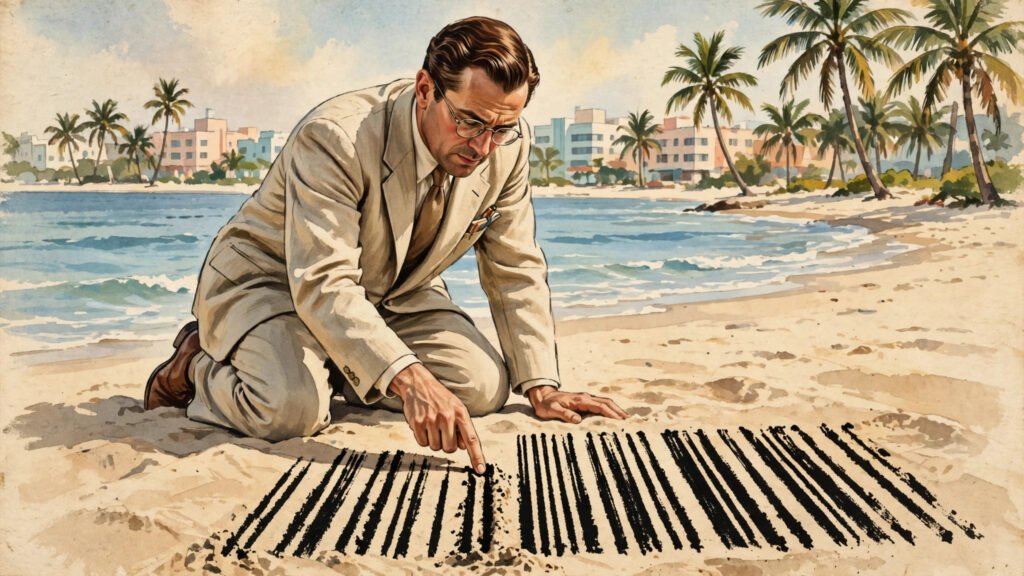
How the barcode was born is a beach story. In 1948, graduate student Norman Joseph Woodland, stuck on how to automate a supermarket checkout, drew lines in the sand at Miami Beach — stretching Morse code dots and dashes into wide and narrow bars. That doodle became the 1952 barcode patent, and twenty-six years later it became the black-and-white stripes on everything you buy.
What Problem Was the Barcode Trying to Solve?
Every invention starts with an annoyance, and the barcode’s was the supermarket checkout queue. By the late 1940s, American supermarkets were booming — bigger stores, more products, longer lines — and every price had to be keyed in by hand. A local food-chain president, frustrated by the bottleneck, visited the Drexel Institute of Technology in Philadelphia and asked the dean whether researchers could build a system that read product information automatically at the till.
The dean passed the request to a young graduate student named Bernard Silver. Silver mentioned it to his friend Norman Joseph Woodland, a fellow Drexel graduate who had already left to work on other projects. Woodland took the problem seriously — seriously enough to quit his job, move into his grandmother’s apartment in Miami Beach, Florida, and think about it full-time through the winter of 1948–49.
The timing matters. Computers were still room-sized curiosities, lasers did not exist yet, and there was no obvious way for a machine to “read” a product. Woodland had to invent not just a code, but a whole way of machines seeing.
Why Did Woodland Draw Lines in the Sand?
Woodland already knew Morse code from his time as a Boy Scout and his wartime work. Sitting on Miami Beach, he started thinking about the code differently: what if a dot and a dash were not tapped out in time, but stretched out in space? A dot became a thin line; a dash became a thick line. Drawn side by side, those lines could encode numbers — and a machine that shone light on them could read the pattern by the light reflected back.
Legend has it that Woodland drew those first lines in the sand with his fingers, four lines of varying widths, and realised he had the core of the idea. The story may be tidied up in the retelling — Woodland himself told it in later interviews, and the sand detail stuck — but the leap itself is documented: Morse code, turned sideways, became a visual language for machines.
Back in Philadelphia, Woodland and Silver built a working prototype. Their first design was not the rectangle of stripes we know today. It was a bull’s-eye: concentric circles of thick and thin rings, so the code could be read from any angle. They filed for a patent on 20 October 1949, and on 7 October 1952 they were granted US Patent 2,612,994 for a “Classifying Apparatus and Method” — the first barcode patent in history.
The patent, though, was ahead of its technology. Reading the code needed bright light and sensitive sensors that were expensive and unreliable in 1952, and no store wanted to pay for a system nobody else used. That year, Woodland and Silver sold the patent to the electronics firm Philco for just $15,000. Bernard Silver died in 1963, a decade before his invention ever scanned a single product in a shop.
Why Did the Barcode Take 25 Years to Reach a Checkout?
Woodland did not give up. In 1951 he joined IBM, and he kept working on the idea there through the 1950s and 1960s while the world slowly caught up. Two things had to happen before the barcode could work: a cheap, reliable way to read it, and an industry-wide agreement on what the code should say.
The reading problem was solved by the laser. When the first practical lasers appeared in the 1960s, a scanner could sweep a beam across the code quickly and accurately — far better than the bulky lamps of the 1950s. Meanwhile, the grocery industry was feeling the same pain that had driven the original request: by the early 1970s, American supermarkets stocked thousands more products than they had in 1948, and checkout queues were worse than ever.
In 1973, the grocery industry’s Ad Hoc Committee on the Uniform Grocery Product Code chose a standard: the Universal Product Code, or UPC. The winning design was not Woodland and Silver’s bull’s-eye. It was a rectangular barcode designed by George Laurer, an IBM engineer who worked with Woodland. Laurer’s bars were easier to print on packaging — a bull’s-eye smudged badly when ink spread, but straight bars survived the printing press. Woodland’s idea had won; his shape had lost to a better one. He reportedly took it graciously: the point had always been the code, not the circles.
What Was the First Product Ever Scanned?
The answer is almost too perfect to be true: a pack of chewing gum. On the morning of 26 June 1974, at a Marsh Supermarket in Troy, Ohio, a cashier named Sharon Buchanan slid a 10-pack of Wrigley’s Juicy Fruit gum across the new scanner. It beeped. The gum was chosen partly by chance — it was small, and its barcode fitted neatly — and partly by history: Wrigley’s was one of the companies that had backed the UPC standard. That pack of gum is now in the Smithsonian’s National Museum of American History.
From there, adoption was slow and then sudden. By the end of 1974 only a handful of stores had scanners. Retailers hesitated at the cost; manufacturers hesitated at printing codes nobody could read. But the logic was unstoppable: a scanned checkout was faster, stock counts became automatic, and pricing errors fell. By the 1980s the barcode was everywhere, and by the 2000s it had spread far beyond groceries — to boarding passes, hospital wristbands, parcels, and library books.
Woodland lived to see all of it. He received the National Medal of Technology in 1992, and he died on 9 December 2012, aged 91, in Edgewater, New Jersey. By then the barcode he had doodled in the sand was being scanned billions of times a day around the world — one of the most successful inventions of the twentieth century, born from a problem nobody else thought worth quitting a job over.
So Why Does the Barcode Still Matter?
The barcode’s real legacy is not the stripes. It is the idea that the physical world can carry machine-readable information — that an object can tell a computer what it is, just by being looked at. Every QR code you scan, every parcel you track, every contactless ticket you tap descends from Woodland’s lines in the sand. The checkout beep we barely notice today began as a graduate student, a beach, and a code borrowed from dots and dashes.
Frequently Asked Questions
How was the barcode invented?
In 1948, Drexel graduate Norman Joseph Woodland, working on a supermarket executive’s request for an automatic checkout system, adapted Morse code into visual form: dots and dashes stretched into thin and thick lines. He and Bernard Silver patented the idea in 1952 (US Patent 2,612,994); the grocery industry adopted the rectangular UPC version in 1973.
Who invented the barcode?
Norman Joseph Woodland and Bernard Silver invented the barcode. Woodland came up with the line-code concept on Miami Beach in 1948–49, and the two filed the first barcode patent together in 1949. IBM engineer George Laurer later designed the rectangular UPC barcode that became the standard.
What was the first barcode ever scanned?
A 10-pack of Wrigley’s Juicy Fruit chewing gum, scanned on 26 June 1974 at Marsh Supermarket in Troy, Ohio, by cashier Sharon Buchanan. The pack is now held by the Smithsonian’s National Museum of American History.
Why was the first barcode a bull’s-eye?
Woodland and Silver’s original 1952 design used concentric circles so the code could be read from any angle. The rectangular bar design won out in 1973 because straight bars printed more reliably on packaging than circles, which smeared when ink spread.